
Close

en

A Go To Market Strategy to Conquer Latin America’s Mobile Market

Last year, we published the Global Mobile Games Landscape and highlighted the true potential of emerging mobile markets. We also dedicated a special series to Asia Pacific, ‘The Asian Beat’, to dig deeper and uncover both similarities and differences within the region and help developers and mobile marketers guide their go to-market strategies.

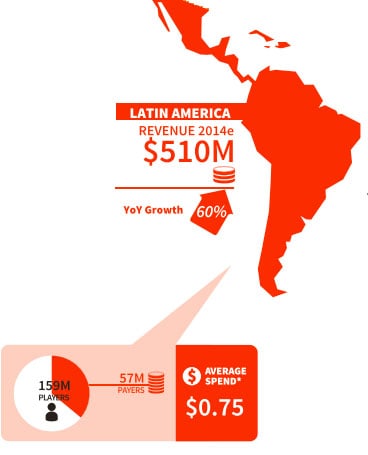
Most recently, Latin America has been drawing more and more attention, positioning itself in the global mobile marketing spotlight. Among recent changes: improved infrastructures, increased smartphone penetration and the rise of cheap mobile data.

In a recent report, eMarketer highlighted the growth of the mobile landscape in Latin America. In 2014, 20% of the population owned a smartphone on the continent. By the end of 2015, this figure should be 25%, and, by 2018, it will be a full third. Latin America is proving to be a strong contender in the mobile global app opportunity, expanding beyond borders and app verticals.

These important developments led us to put together the top 10 tips on why and how to invest in LatAm. To get a more in-depth understanding, we sat down with two experts in the region:(Patricio D’Amato, CMO of Recarga, as well as our very own VP International Hugo Gersanois), to get a better feel of what makes this region different and why is it worth considering and how you can adapt your go to market strategy. 

Demand vs. Supply In Mobile Advertising: Resolving the Inevitable AdTech Conflict

AppLift recently announced the acquisition of Bidstalk, an enterprise DSP provider with some amazing technological capabilities, thereby adding another important ingredient to our demand stack. This evolution didn’t come in a day, but was rather the result of our market vision and our understanding of the future of adtech (advertising technology) and martech (marketing technology, solutions enabling you to manage your existing customer base).

Here I would like to give a bit more background on one of the main reasons why it was important for us to invest in a programmatic DSP with RTB capabilities and, having spent years on both the demand as well as the supply side, explain how I see the industry evolving forward.

Three Ways to Feed Consumers’ Hunger for Mobile Gaming, While Respecting Their Privacy

Back in 2008, the world changed. Apple introduced its first ever iPhone and a store to house small icons that led to larger applications, called apps, that could be downloaded to your device – the App Store. Since then, an entire and very profitable industry has been built around app design and development. The App Store offers nearly 1.5 million apps in 24 categories, including social networking, gaming, photo & video, health & fitness, travel, to name a few.

The most successful category of apps continues to be gaming. According to a report from The NPD Group, the average time spent playing mobile games in 2014 increased by 57% compared to 2012, with three hours daily playing games on our mobile devices and tablets. This explains why this business has become so successful over the years, and it’s not stopping. A recent study predicts that the total revenue for mobile gaming will hit $30 billion in revenue in 2015 and $40 billion in 2017, up from $25 billion in 2014.

Embracing a Programmatic Future: AppLift Acquires Mobile DSP Bidstalk

Today we are very excited to announce that AppLift has acquired Bidstalk, one of the world’s leading mobile demand side platforms (DSP). Bidstalk is headquartered in Singapore, with an additional R&D center in Bangalore, India. Its technology enables mobile marketers to buy RTB-traded inventory through a self-serve interface offered on a white-label basis and works with over 40 DSPs, including some of the biggest names in the RTB space, delivering over 40 billion impressions a day. – See more at: http://applift.sohocreative.eu/en/blog/applift-acquires-ds…

App Localisation: How to Unlock Revenue Overseas

The mobile ecosystem has expanded rapidly over the last 5 years, with smartphones and mobile applications now being accessible in nearly every corner of the earth. The Apple App Store supports 155 countries in 28 languages, whilst Google Play has free applications available almost worldwide and supports 46 different languages.

In combination with global growth, app monetisation channels have matured considerably and emerging markets are now being recognised as much more lucrative than before.

Industry Exposed #15: Apptentive “Customer Acquisition Is Only Half the Battle; The Real Challenge is Retention”

Welcome back to our Industry Exposed series where we speak with professionals from the mobile marketing landcape to get first hand in-depth knowledge. This time we spoke with Robi Ganguly, co-founder and CEO of Apptentive, about the misconception of focusing on customer acquisition versus retention, the value in ratings and reviews and demand for data-driven mobile marketing.

Industry Exposed #14: Paddle “Fingerprint Sensors Will Really Help m-Commerce Take Off”

Welcome back to our Mobile Industry Exposed interview series! This time we spoke with Christian Owens, founder and CEO of Paddle, about the importance of creating your monetization strategy taking into account your user. He also touched upon ways to fight m-commerce cart abandonment and explained the direct value of measuring in-app metrics such as location, device and OS version.Christian Owens is the Founder & CEO of Paddle.com. Paddle makes it incredibly simple for developers to sell & manage their apps from a single dashboard, with a range of tools for payments, analytics and more.

Five Reasons Why Mobile Advertisers Should Love Programmatic Media Buying

Programmatic media buying has been around for a while, but there are still a lot of people who don’t really know what it is. That’s about to change, because programmatic media buying is going mainstream, and mobile advertisers need to start planning now to avoid being left behind.

What is programmatic media buying?

Programmatic media buying is an offshoot of another buzzword: big data. Big data gave businesses invaluable insights into consumer buying habits. But that information didn’t do any good just sitting around on a bunch of servers, so marketers had to figure out how to analyze it and apply what they found. The computing power to do that has been around for a while now, but there was still one technological roadblock: the process for buying media. The existing process wasn’t sophisticated enough to capitalize on all of that information. Programmatic media buying is changing that by letting marketers automatically buy and run media campaigns with granular segmentation. And the mobile market is beginning to embrace it enthusiastically.

Asian Beat #8: Four Insights Into the Malaysian Mobile Games Market

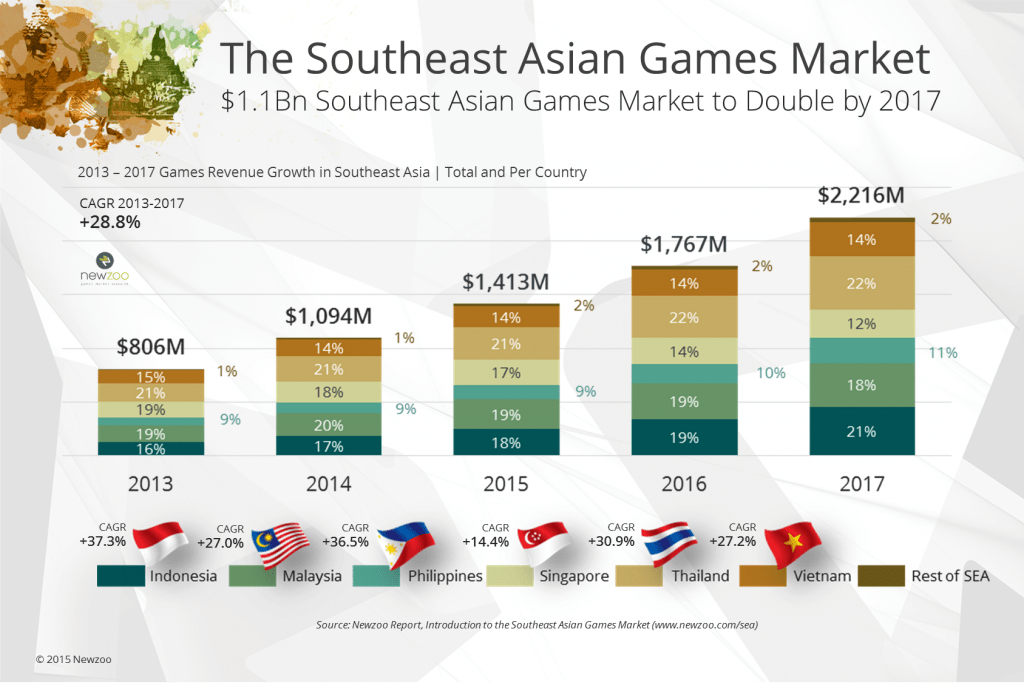
Welcome to the eighth installment of our Asian Beat series! After Vietnam and Thailand, Malaysia is the third South-East Asian country to fall under our microscope.This time again, we teamed up with games research company Newzoo to explore this market. Malaysia is an interesting country, because it is extremely diverse culturally and linguistically. The Malaysian games market, and mobile in particular, is due to grow impressively in the years to come, which makes it a suitable destination to roll out your game in South-East Asia.Here are our top 4 insights into the Malaysian mobile games market!

User Satisfaction: Four Reasons Your Mobile App is Bleeding Out Users

Getting Users Is Hard

There’s now millions of apps in both app stores, watches to pull attention away from the phone screens and terrifying increases in cost of customer acquisition. It is clear that the key to retention is user satisfaction.

Keeping Users Is Harder

Tapstream put together the data and we’ve seen brutal drops in day one retention. Day seven and thirty weren’t nearly as dramatic, but day one is where everybody is falling off the cliff. What makes day one such a challenge? Here’s four reasons you might be bleeding out users and three ways to plug the holes.

X